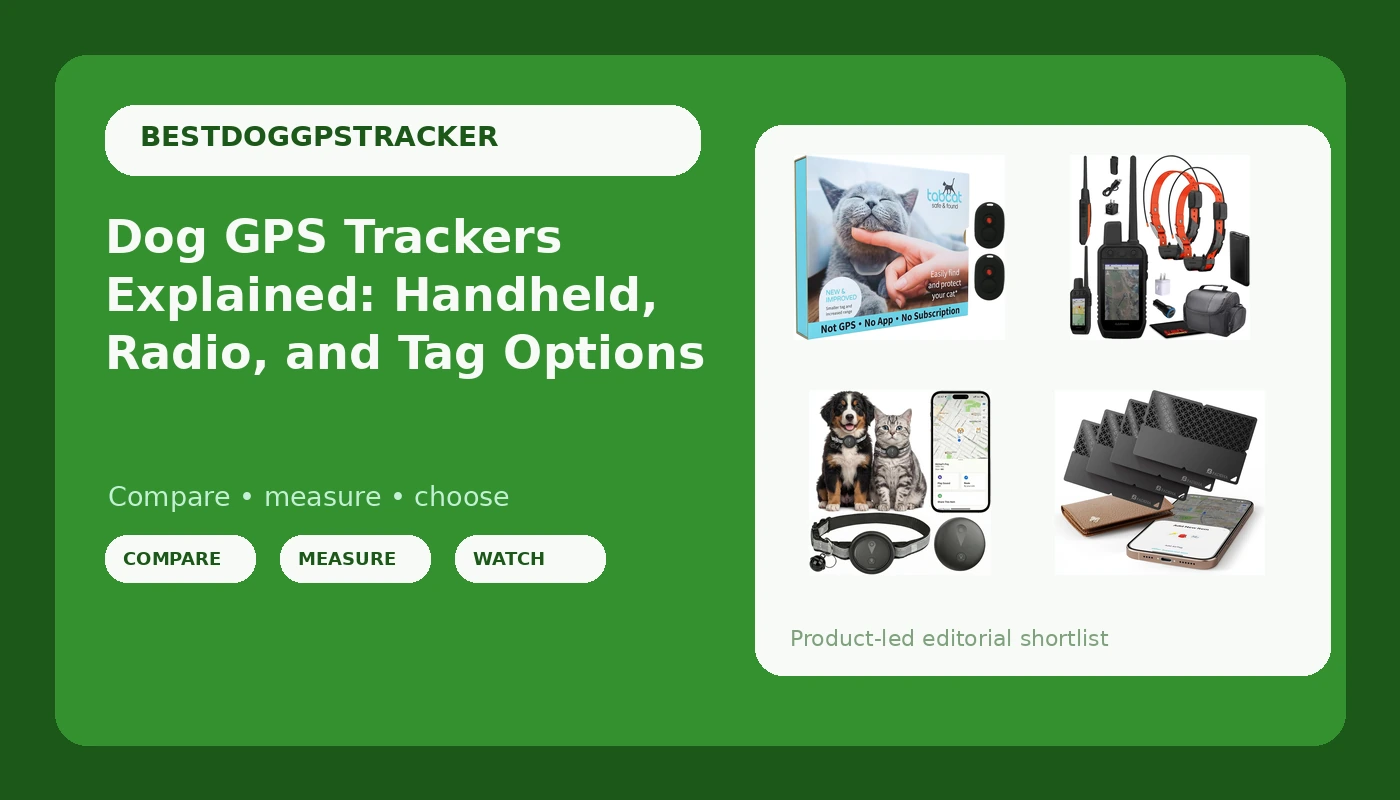
Most people start shopping for a dog GPS tracker after the dog has already gone through the fence once. The second time, they read the listings closely, and that is when the confusion starts: Bluetooth tags sold as GPS, radio homing tags with a short range ceiling, and handheld systems that cost more than a used trailer. The dog GPS tracker options on this page fall into four genuinely different categories, and the category matters far more than the brand name. One of them keeps working where your phone has no bars. One is subscription free but only reaches a short distance. One is a listing you have to read carefully. One is not a dog tracker at all, and it is still worth owning.
Related: What a Dog GPS Tracker Subscription Really Costs Over Three Years →
Quick answer
The right tracker depends on where your dog runs and whether that place has cell coverage. A handheld and collar system is the only category here that is built to keep working with no cell signal. A radio homing tag is subscription free but short range. A general purpose pet tracker listing has to be read carefully, because the name alone does not say which technology is inside. A Find My item card is excellent for keys, bags, and gear, and it is not a dog tracker.
Four useful options
| Model | Best fit | What stands out |
|---|---|---|
| Garmin Alpha 300 Handheld Dog Tracking with 2X Alpha TT25 Dog Collar Bundle | Off grid hunting, trail, and backcountry dogs | A handheld plus two collars in one bundle, so two dogs track from one screen |
| Tabcat V2 Cat & Kitten Tracker - More Accurate Than GPS - No Monthly Fee or Subscription - Includes 2 Homing Tags - Up to 150m Range - Small & Lightweight Tags Perfect to Find Indoor & Outdoor Cats | Cats and indoor outdoor pets inside a small radius | The listing describes radio homing tags, two of them, with no monthly fee and up to 150 m of range |
| Tracker - Ideal for Small, Medium, and Large Pets | Owners comparing basic options on a budget | The listing spans small, medium, and large pets, so read it for the actual technology |
| 2026 Apple MFi Certified Wallet Tracker Smart Card for Find My iPhone Ultra Thin Air Tracker Tag for Travel, 5 Years+ Staying Power, IP69 Waterproof, Key Finder & Item Locator for Keys, Bags, Passport | Keys, bags, crates, and travel gear | MFi certified for Find My, ultra thin card shape, and an IP69 waterproof rating in the listing |
Off grid handheld system: Garmin Alpha 300 Handheld Dog Tracking with 2X Alpha TT25 Dog Collar Bundle
This is the category I trust in deep canyons and dense pines, and it is also the one that costs the most up front. Handheld and collar systems in this family put the positioning hardware on the dog and a radio link back to the unit in your hand, which is why they keep working when your phone shows no service. The bundle includes two collars, so if you run two dogs you are not buying a second kit later. The trade off is weight and bulk on the collar, plus a handheld you have to carry and charge. If your dog only ever runs in a fenced suburban yard, this is more machine than you need.
Short range homing tag: Tabcat V2 Cat & Kitten Tracker - More Accurate Than GPS - No Monthly Fee or Subscription - Includes 2 Homing Tags - Up to 150m Range - Small & Lightweight Tags Perfect to Find Indoor & Outdoor Cats
This one sits outside this site's usual lane, since it is built for cats and cat escapes follow different physics than dog escapes. It earns a place here because multi pet households keep asking about it, and because the trade off it represents is worth understanding. Radio homing gives you a direction and a signal strength, not a map pin, and the listed range is roughly a football field plus a bit. Inside that radius it can be very precise. Outside it, the tag is silent. No subscription is a real advantage over three years of cellular fees, but it is not a replacement for a tracker that reports a position from three miles away.
The generalist listing: Tracker - Ideal for Small, Medium, and Large Pets
This is the listing that represents the whole crowded middle of the market, and it is the one that teaches the most important shopping habit: a product title is not a specification sheet. The name tells you the size range it is meant for. It does not tell you whether the thing inside is Bluetooth, radio, or satellite, and that single detail decides whether it helps you at all when your dog leaves the yard. Open the listing, find the words that describe how it locates a pet, and check whether it needs a subscription. If the answer is Bluetooth, treat it as a yard tool and nothing more.
Item and gear tag: 2026 Apple MFi Certified Wallet Tracker Smart Card for Find My iPhone Ultra Thin Air Tracker Tag for Travel, 5 Years+ Staying Power, IP69 Waterproof, Key Finder & Item Locator for Keys, Bags, Passport
Find My accessories locate themselves by borrowing nearby Apple devices, which makes them superb at finding keys, a go bag, or a crate left at the trailhead, and unreliable as pet trackers in country where the nearest phone belongs to you. I keep one in my truck kit and one in my search pack. A card like this in a harness pocket is a backup, not a plan, because it reports nothing where nobody walks. Read the two claims in the listing that matter most for gear use, the IP69 rating and the long service life, and ignore any marketing that implies it works like a satellite collar.
Prices and availability may change. Product images, names, and retailer links are matched to verified listings. No current price, rating, stock status, or measured result is stated here without current evidence.
How trackers actually find your dog
Four technologies show up in pet tracking, and mixing them up is the most expensive mistake in this category. Satellite positioning, usually described as GNSS, lets a collar work out where it is without any help from a phone network, but the position still has to reach you somehow, either over a radio link to a handheld or over a cellular data plan. Cellular trackers are cheap to build and easy to use, and they stop reporting the moment your dog runs into a drainage, a canyon, or a national forest dead zone. Radio homing, the approach behind the short range tag above, sends a signal you follow by hand, which is wonderfully precise at close distance and useless past its listed range. Bluetooth item trackers piggyback on other people's phones, which is why they shine in cities and fail in the backcountry.
That is why the phrase unlimited range should make you suspicious. Range is a physical property, and every product here has a real one, whether it is written in the listing or not.
What the subscription really costs
A tracker with a monthly fee is not a cheaper tracker. It is a tracker plus a contract. At the common ten to fifteen dollars a month, three years of service runs somewhere between roughly three hundred and sixty and five hundred and forty dollars, which in most cases is more than the hardware itself. That math changes which product is actually affordable, and it is the number I calculate before I recommend anything to a friend.
Three questions settle it. Does the tracker work at all without a paid plan? Does the plan auto renew, and can you pause it for the months your dog stays home? And does the app still show a last known location after the subscription lapses? A tracker that turns into a paperweight the month you stop paying is a rental, not a purchase.
- Map where your dog actually runs, and check honestly whether that ground has cell coverage.
- Decide whether you need off grid operation, or whether a fenced yard and a short radius are your real world.
- Weigh the collar, not just the tracker, since a heavy unit on a small dog changes how the dog moves.
- Add three years of subscription to the sticker price before you compare anything.
- Run a recovery drill in your own yard and time how long it takes you to locate a hidden collar.
Keeping a tracker on a dog in the field
- Fit the collar snugly enough that two fingers slide under it, because a loose collar slips over a husky's head in brush.
- Check the attachment weekly. I have found two trackers in the woods and neither was on a dog.
- Charge on a fixed day, not when the battery warning appears, since a tracker that dies at hour fourteen of a hike is a rock.
- Confirm the waterproof rating meets your dog's habits, and treat IP67 as the floor if your dog swims or rolls in creeks.
- Test the geofence and the last known location view before you need them, ideally while standing next to your dog.
- Keep a light or a beacon feature in mind for night recovery, because a silent collar in dark timber is nearly impossible to spot.
Which option should you choose?
Choose the Garmin Alpha 300 Handheld Dog Tracking with 2X Alpha TT25 Dog Collar Bundle when your dog runs off grid and you want a handheld and two collars that do not depend on a cell tower. Choose the Tabcat V2 Cat & Kitten Tracker when your pet stays inside a short radius of home and you want no monthly fee, with the honest caveat that it is a homing system rather than a map. Choose the Tracker - Ideal for Small, Medium, and Large Pets when you want a low cost starting point and are willing to read the listing carefully to find out what is actually inside. Choose the Apple MFi Certified Wallet Tracker Smart Card when the thing you keep losing is your keys, your bag, or your passport rather than your dog.
Two caveats belong here. Listing claims, including range figures and accuracy comparisons, come from the seller and not from measurements taken on this page. And no tracker replaces a recall, a fence, or an ID tag, because the technology is a recovery tool and not a containment system.
The bottom line
Match the technology to the terrain and the decision gets simple. Off grid dogs need a handheld and collar system. Short radius pets can live happily with a subscription free homing tag. Budget shoppers should read the listing before trusting the title. And a Find My card belongs on your keys, where it will genuinely save you. Whichever you pick, budget the subscription if there is one, fit the collar properly, and run a drill before the day you actually need it.